

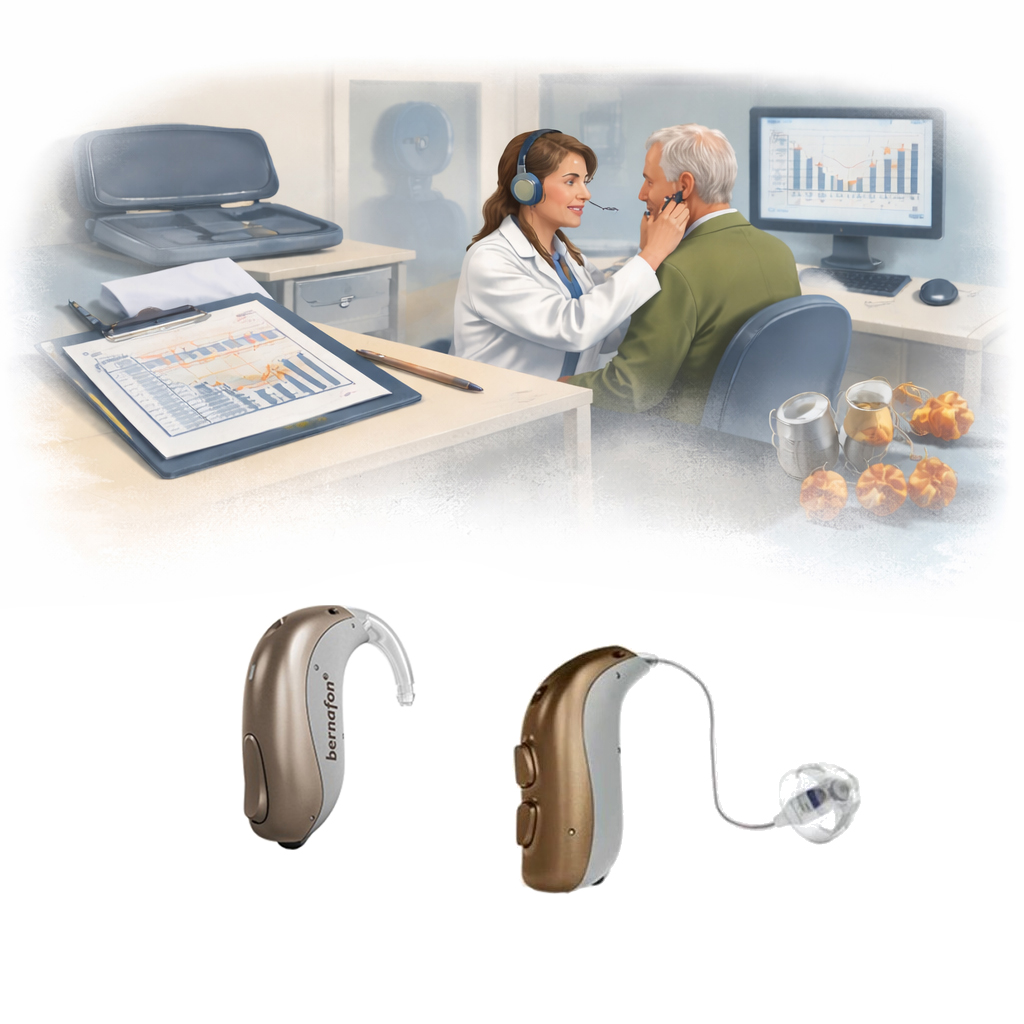
How to determine the power of a hearing aid?
What Degrees of Hearing Loss Require Different Hearing Aid Power Levels
Determining device parameters begins with assessing the severity of hearing loss. Different degrees of hearing loss require varying levels of compensation, as the range of reduced sound sensitivity can differ significantly. The required hearing aid power and its technical characteristics depend directly on these indicators.
With mild hearing loss, basic amplification is often sufficient to compensate for difficulty hearing soft sounds and speech at a distance. Mild and severe hearing loss require fundamentally different approaches: in the first case, it is important to preserve natural sound quality, while in the second, it is necessary to ensure sufficient speech clarity even in noisy environments.
A moderate degree of hearing loss предполагает a wider adjustment range. The device must amplify speech without causing discomfort or distortion. In cases of significant hearing impairment, higher hearing aid power is required to compensate for elevated hearing thresholds.
The patient’s dynamic hearing range is also taken into account — the difference between the softest audible sound and the maximum comfortable loudness level. Incorrectly selected power may lead to auditory overload or, conversely, insufficient compensation.
The Role of the Audiogram in Selecting Hearing Aid Amplification
The foundation of professional fitting is the hearing audiogram — a chart that reflects sensitivity to different frequencies. It allows specialists to determine which sounds a person cannot perceive and in which frequency range correction is needed.
Accurate audiogram interpretation helps precisely calculate hearing aid amplification across frequencies. This is essential because hearing loss is rarely uniform; more often, specific frequency zones are affected.
When analyzing the data, the specialist considers:
-
hearing thresholds at low and high frequencies;
-
symmetry or differences between the right and left ears;
-
progression of hearing changes;
-
sensitivity to loud sounds.
How Audiogram Data Affects Fitting Accuracy
Based on the obtained results, an initial device program is created. After that, individual hearing aid adjustment is performed, taking into account the patient’s real-life perception in various acoustic environments.
Additionally, the following factors are evaluated:
-
speech intelligibility;
-
comfort of environmental sound perception;
-
response to background noise;
-
tolerance of amplification throughout the day.
Only a comprehensive analysis ensures accurate hearing aid amplification without distortion or overload of the auditory system.
Why It Is Important to Consider Individual Characteristics When Choosing a Hearing Aid
Even with identical test results, patients may perceive sound differently. Individual hearing characteristics influence comfort and the effectiveness of correction, which is why standard solutions are not suitable for everyone.
Hearing aid selection should take into account age, lifestyle, professional demands, and acoustic environment. For example, a person working in a noisy office may need one configuration, while an elderly user may require another.
Anatomical features of the ear canal, sensitivity to loud sounds, and the speed of adaptation to amplification are also important. These factors directly affect the final outcome and daily wearing comfort.
A comprehensive approach that includes diagnostics, data analysis, and consideration of personal parameters allows for stable results and improved quality of life without unnecessary acoustic discomfort.