

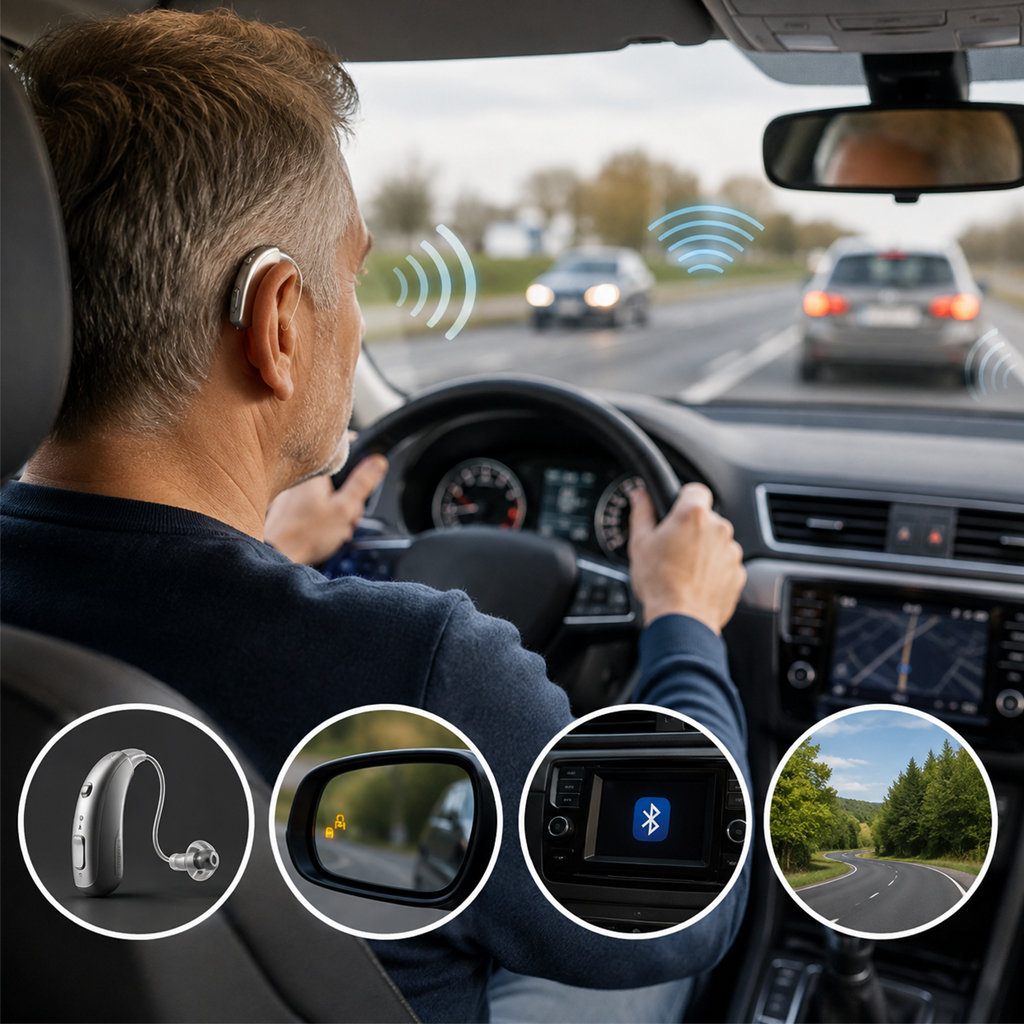
How to Choose a Hearing Aid for Driving?
For drivers, it is important not only to hear speech clearly but also to perceive sounds around the vehicle: signals from other cars, sirens, passenger warnings and other important auditory cues. Therefore, a hearing aid for driving should provide good speech intelligibility while maintaining a natural perception of the surrounding environment.
When choosing a device, it is important to consider not only the degree of hearing loss but also everyday driving conditions, the level of road noise and the need to use a phone while driving.
How to Choose a Hearing Aid while Driving
For drivers, the ability of a hearing aid to adapt to changing acoustic conditions is particularly important. The inside of a car can be relatively quiet, but while driving there is constant noise from the engine, tires, ventilation and other vehicles.
A hearing aid should help the user perceive speech and important sounds without making the surrounding environment excessively loud.
Directional Microphones
Directional microphones can help focus on sounds coming from a particular direction. This can be especially useful when talking to a passenger sitting nearby.
However, completely isolating sounds from other directions is not desirable. Drivers need to remain able to hear surrounding auditory signals, so the settings should take into account how the hearing aid will be used while driving.
Which Features Are Important for Drivers
Modern hearing aids can automatically adapt sound processing depending on the surrounding environment. This can be particularly convenient for drivers because conditions inside the vehicle constantly change.
When choosing a device, pay attention to:
- high-quality speech processing;
- adaptive noise reduction;
- directional microphones;
- automatic program switching;
- the ability to connect to a smartphone;
- stable performance when the level of surrounding noise changes.
At the same time, having a large number of features does not automatically mean that a model will be better. More important is that the device is properly selected and programmed according to the user’s hearing needs.
Why Speech Intelligibility Is Important
During a trip, a driver may need to communicate with a passenger, talk on the phone through an approved hands-free system or receive voice navigation instructions.
Speech Intelligibility
If a hearing aid simply amplifies all sounds equally, road noise can interfere with speech perception. This is why signal-processing technologies that help make voices more intelligible can be useful.
This is especially important when driving on highways or in cities with heavy traffic.
How a Hearing Aid Helps You Hear Sounds Around You
For drivers, it is important to maintain awareness of the surrounding sound environment. Excessive noise reduction can make some sounds less noticeable, so the settings should be balanced.
Traffic Sounds
Car signals, emergency sirens and other sounds can come from different directions. Therefore, when programming a hearing aid, it is important to tell the specialist that the device will be used while driving.
You should not select a program with maximum noise reduction on your own simply to make the ride quieter. First, make sure that important sounds from the surrounding environment remain clearly audible.
| Feature | Benefit When Driving |
|---|---|
| Directional microphones | Help you hear the passenger’s speech more clearly |
| Adaptive noise reduction | Reduces the impact of constant road noise |
| Speech processing | Improves speech clarity |
| Automatic programs | Allow the hearing aid to adapt to different environments |
| Bluetooth | Convenient for compatible phone systems and navigation |
What to Consider When Using a Hearing Aid While Driving
Before driving, make sure that the hearing aid is positioned correctly and works without unusual noises, feedback or interruptions. If the device has recently been fitted, it is advisable to first get used to it in a quiet environment and only then use it while driving.
Connecting to a Smartphone
Bluetooth can be useful for drivers who use a compatible smartphone or the vehicle’s multimedia system. Navigation audio or permitted phone functions can be transmitted directly to the hearing aid.
At the same time, using a phone while driving must comply with traffic regulations and should not distract the driver.
Why Individual Programming Is Important
Even a feature-rich hearing aid may be inconvenient for driving if its settings do not match the user’s hearing needs. A specialist takes the audiogram results into account and can adapt the device to different listening environments.
If speech remains difficult to understand while driving, road noise seems too loud, or some important sounds become less noticeable, additional programming may be necessary.
Frequently Asked Questions
Can you drive a car while wearing a hearing aid?
A hearing aid itself is not an obstacle to driving. What matters is that the driver can adequately perceive the necessary sounds and meets the requirements established for operating a vehicle.
What type of hearing aid is best for driving?
It is generally advisable to choose a model with good speech processing, adaptive noise reduction, directional microphones and the ability to be individually programmed. The specific device should be selected according to the degree of hearing loss.
Should you remove a hearing aid while driving?
No, if the device is working properly and provides comfortable perception of sounds. There is no need to remove it during a trip without a specific reason.
Can Bluetooth be used in a car?
Yes, if the hearing aid, smartphone and vehicle system are compatible. This feature can be convenient for transmitting navigation audio and phone calls.
Conclusion
When choosing a hearing aid for driving, it is important to find a balance between good speech intelligibility and natural perception of surrounding sounds. Drivers need to hear passengers, voice navigation instructions and important auditory signals from the road environment.
Therefore, when selecting a device, it is important to consider not only its technical features but also the conditions in which it will be used. Individual programming and testing the hearing aid in different acoustic environments can help make its use more comfortable while driving.