
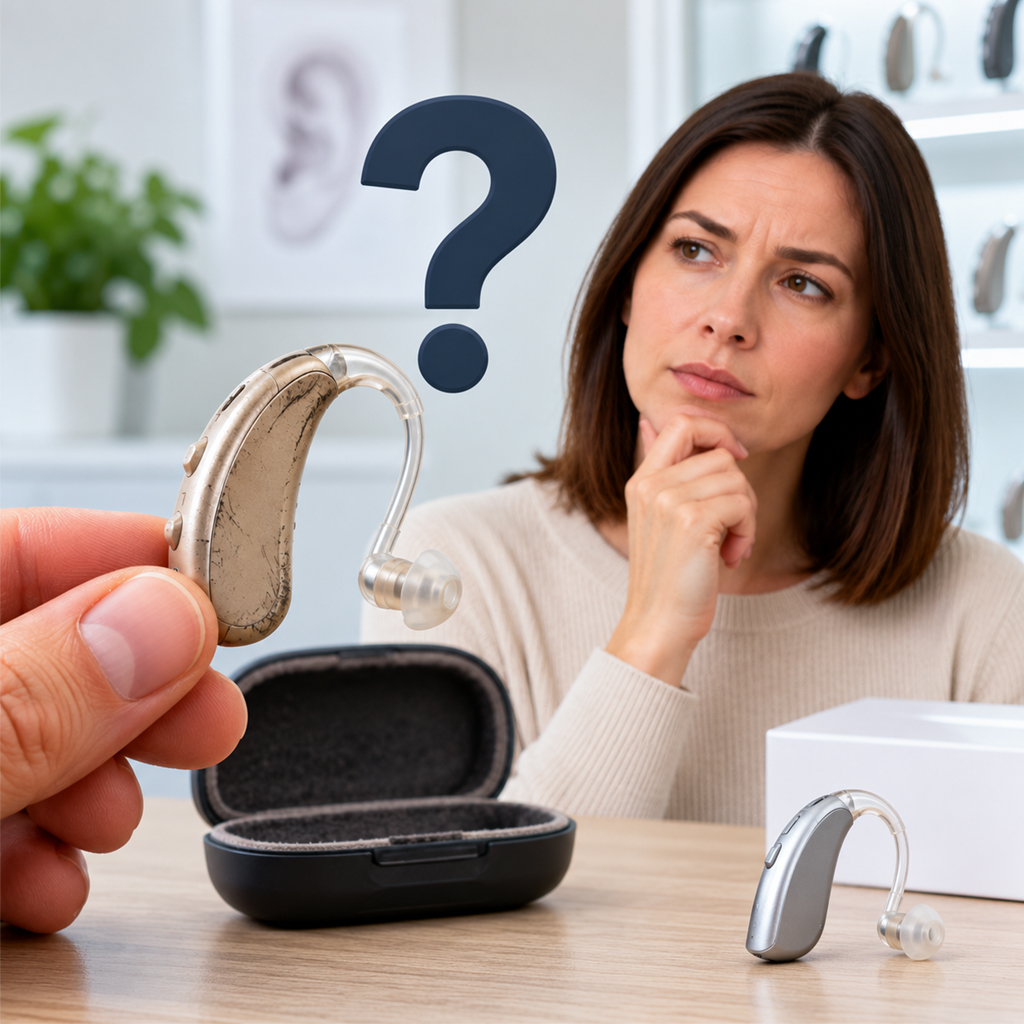
Can you buy a used hearing aid?
Buying a used hearing aid may seem like a way to save money. However, such a device has already been used by another person, so its technical condition, settings and compatibility with the new user’s hearing require special attention. Before buying, it is important to assess not only the appearance of the hearing aid but also its functionality, the possibility of professional adjustment and the condition of its main components.
Can You Buy a Used Hearing Aid?
Technically, you can buy a used hearing aid, but this option is not suitable in every situation. A hearing aid is selected based on a specific audiogram, the degree and type of hearing loss, the characteristics of the ear canal and the user’s lifestyle.
A device that worked well for one person may not be suitable for another. Even if the device turns on and works, this does not necessarily mean that it will provide the required amplification and comfortable speech perception.
Before buying, it is advisable to find out the model, age of the device, its usage history and maintenance history. You should also determine whether you can have the device diagnosed and reprogrammed by a specialist.
What Are the Risks of Buying a Used Hearing Aid?
The main problem with a used device is that some faults may not be noticeable during a basic inspection. For example, the hearing aid may turn on normally but have problems with the microphone, receiver, battery or sound processing quality.
In addition, electronic components gradually wear out. If the device has been used for several years, its technical condition may differ significantly from that of a new hearing aid.
When buying a used hearing aid, consider the following risks:
- hidden technical faults;
- wear of the microphones and receiver;
- reduced battery capacity;
- damage to the casing or contacts;
- inability to fully adjust the device to the new user’s hearing;
- lack of warranty;
- need for additional repair or servicing;
- compatibility issues with accessories and the charger.
Special attention should also be paid to hygiene. The device comes into contact with the skin and the ear area, so it should be thoroughly cleaned and professionally checked before being used again.
What to Check Before Buying a Used Hearing Aid
Before purchasing, do not limit yourself to checking the external condition. Even a well-preserved casing does not guarantee that the electronic components are functioning properly.
Condition of the Casing and Components
There should be no serious cracks, deformation or signs of moisture damage on the casing. Check the battery compartment, contacts, control buttons, charging contacts and other structural components.
If the hearing aid has a rechargeable battery, it is advisable to check how well it holds a charge. An older device may have significantly shorter battery life than originally specified by the manufacturer.
Device Service Life
The age of a hearing aid is important. The longer the device has been used, the greater the likelihood of natural wear of individual components.
It is important to find out not only the year of purchase but also the exact model. Sound-processing technologies and the capabilities of modern devices can differ considerably from those of models released several years ago.
Battery or Battery Compartment Condition
For rechargeable models, check the operating time on a full charge, as well as the condition of the charger and contacts.
For battery-powered hearing aids, check the condition of the battery compartment and make sure there is no corrosion on the contacts.
Compatibility with the User’s Hearing
This is one of the most important factors. A hearing aid must correspond to the degree and type of hearing loss.
Even a fully functional device may be unsuitable if it does not have enough power or if its adjustment range cannot provide the required amplification.
Therefore, before purchasing, it is advisable to have a recent audiogram and consult a hearing care professional.
Can a Hearing Aid Be Adjusted After Purchase?
In many cases, a used hearing aid can be reprogrammed for a new user. However, the possibility of doing this depends on the specific model and the manufacturer’s software.
A specialist evaluates the user’s hearing parameters, checks the device and sets the required amplification levels. However, not every older hearing aid allows for full adjustment.
Therefore, before buying, it is advisable to find out in advance:
- whether the model supports professional programming;
- whether the required software is available for it;
- whether the device can be connected to the specialist’s equipment;
- whether the hearing aid’s power is appropriate for the hearing loss;
- whether the necessary consumables and spare parts are available.
It is not recommended to simply transfer the previous owner’s settings. Parameters that were suitable for one person may be completely inappropriate for another.
What Determines the Safety of Using a Used Device?
The fact that a hearing aid has been previously used does not automatically mean that it is unsafe. The key factors are the device’s technical condition, cleaning, proper programming and compatibility with the user’s hearing.
It is especially important to check the hearing aid after long-term storage. If the device has not been used for several months or years, make sure that the battery, contacts, microphones and other components are in working condition.
It is also advisable to replace or make a new earmold or ear tip if the design of the hearing aid requires one. An old custom earmold was made for another person’s ear canal and may not fit the new user.
When Is Buying a Used Hearing Aid Justified?
A used hearing aid may be considered an option if the user knows the exact model, its specifications and its condition. It is particularly important that the device can be professionally tested and adjusted.
Buying a used device may make sense if:
- the hearing aid is relatively new;
- its usage history is known;
- the device is fully functional;
- the model provides sufficient power;
- professional adjustment is available;
- the necessary components are available;
- the final cost is genuinely lower than that of a new device.
However, the savings should be meaningful. If the device requires repairs, a battery replacement, a new earmold or other components after purchase, the initial financial benefit may be significantly reduced.
Why a New Hearing Aid May Be a Better Choice
A new hearing aid usually offers several advantages over a used device. The user gets a device without previous wear, access to current technologies and the opportunity to choose a model specifically suited to their needs.
When selecting a new hearing aid, a specialist can take into account the results of audiometry, the characteristics of the user’s hearing, daily activities and personal preferences.
Another important advantage is the warranty. When buying a used device, the warranty may be unavailable or may have already expired.
Comparison of New and Used Hearing Aids
| Criterion | Used Hearing Aid | New Hearing Aid |
|---|---|---|
| Cost | Usually lower | Usually higher |
| Component wear | Possible | Minimal |
| Warranty | May be unavailable | Usually provided |
| Adjustment | Requires reprogramming | Performed during fitting |
| Battery condition | Depends on service life | New |
| Hygiene | Requires thorough inspection and cleaning | Previously unused |
| Technology | Depends on the age of the model | Current models can be selected |
| Hearing compatibility | Must be carefully checked | Selected individually |
When Should You Consult a Specialist?
Before buying a used hearing aid, it is advisable to get professional advice. A specialist can assess whether a particular model is suitable in terms of power and adjustment capabilities.
After purchasing the device, a diagnostic check is also recommended. This can reveal problems that cannot be identified simply by examining the appearance or briefly testing the device.
If the hearing aid causes discomfort, feedback, excessive loudness or does not provide adequate speech understanding, it should not be used further without professional inspection.
Frequently Asked Questions
Can I buy a hearing aid that was used by someone else?
Yes, but before buying it is necessary to check the technical condition of the device, its age, the possibility of adjustment and its compatibility with the new user’s hearing.
Can a used hearing aid be adjusted for another person?
In many cases, yes, but this depends on the model and its programming capabilities. The adjustment should be performed by a specialist based on a recent audiogram.
Is it worth buying an old hearing aid to save money?
It depends on the condition and price of the device. If the hearing aid requires repairs or replacement of expensive components, the savings may be insignificant.
Can I use the previous owner’s old earmold?
It is better not to use it without inspection. The earmold should fit the user’s ear, and from a hygiene perspective, a new or individually made option is preferable.
Conclusion
You can buy a used hearing aid, but this type of purchase requires considerably more attention than buying a new device. It is important to check the technical condition, service life, battery or battery compartment, adjustment options and compatibility with the user’s specific hearing loss.
The main point is not to choose a device based solely on price. Before using a used hearing aid, it is advisable to have it inspected by a specialist who can check its operation and adjust it to the new user’s hearing. If the cost of a used model, including possible repairs and servicing, is close to the price of a new device, buying a new hearing aid is often the more rational option.