

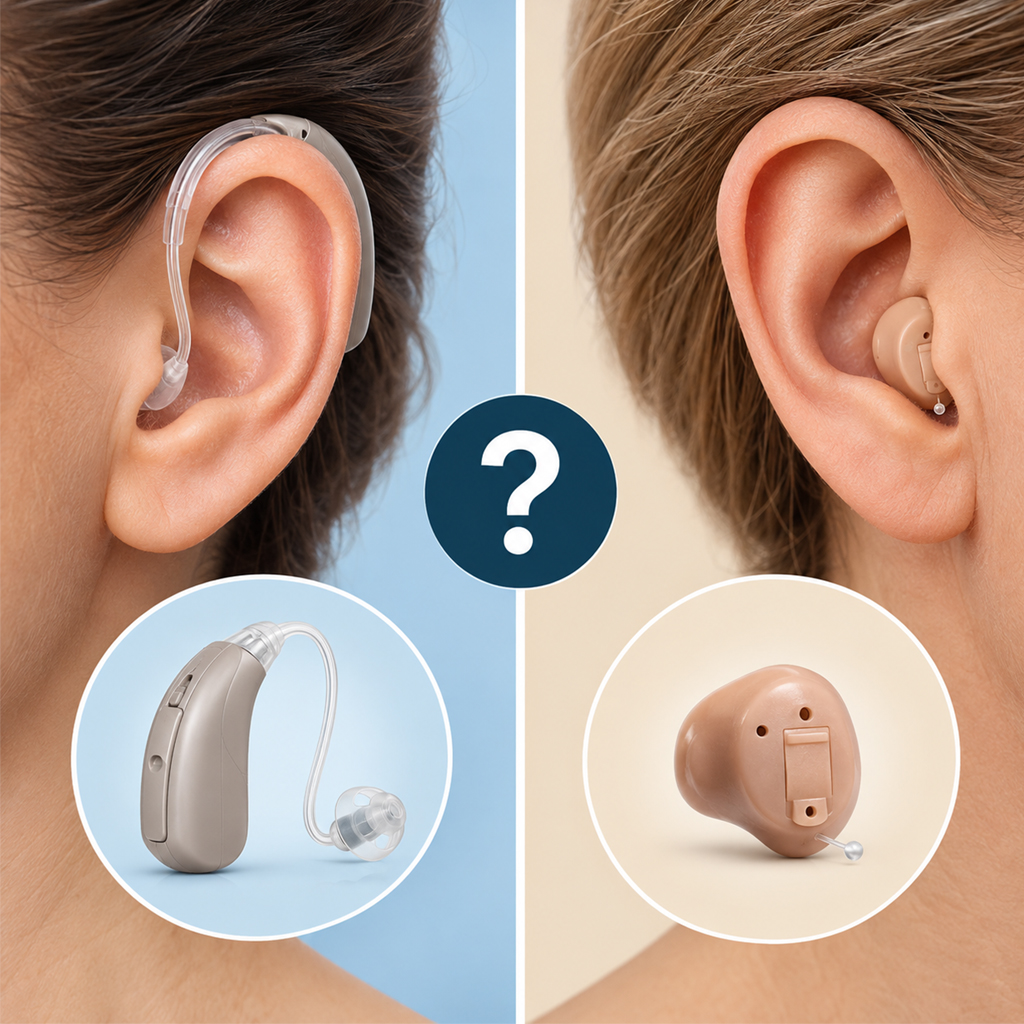
What is the difference between behind-the-ear and in-the-ear hearing aids?
Behind-the-ear and in-the-ear hearing aids differ in their design, placement, sound amplification, and care requirements. Behind-the-ear models are positioned behind the ear, while in-the-ear models are placed directly in the outer ear or ear canal. Each option has its own features that should be considered when selecting a device.
Key Differences Between Behind-the-Ear and In-the-Ear Hearing Aids
The main difference lies in the location of the device housing and the way amplified sound is delivered. A behind-the-ear hearing aid sits behind the ear and connects to an ear mould, tube, or receiver. An in-the-ear model is positioned directly in the ear, so its housing is designed according to the shape of the outer ear and ear canal.
The design affects not only the appearance of the device but also its capabilities. For example, behind-the-ear models can have a relatively larger housing that contains microphones, a processor, a rechargeable battery, or a battery compartment. This allows components designed for different levels of amplification to be used.
An in-the-ear hearing aid has a more compact arrangement of components. Depending on the design, it may occupy part of the outer ear or be positioned deeper inside the ear canal.
| Characteristic | Behind-the-ear hearing aid | In-the-ear hearing aid |
|---|---|---|
| Placement | Behind the outer ear | In the outer ear or ear canal |
| Size | From compact to larger models | Usually compact |
| Power | Options are available for different degrees of hearing loss | Depends on the design and size |
| Visibility | The housing is positioned behind the ear | May be less noticeable |
| Care | Requires cleaning of the housing, ear mould, and other components | Requires regular cleaning of the housing and sound outlet |
| Controls | May include buttons or other controls | Control options depend on the model |
Features of Behind-the-Ear Hearing Aids
A behind-the-ear model is positioned directly behind the outer ear. Sound from the device is delivered into the ear through tubing with an ear mould or through a thin sound tube and receiver positioned near the ear canal.
Design and Operating Principle of Behind-the-Ear Models
The housing contains the main electronic components, including microphones, a signal processor, a power source, and other elements. Depending on the design, the receiver may be located directly inside the housing or positioned closer to the ear canal.
A behind-the-ear hearing aid can have different housing designs and adjustment options. This makes it possible to adapt the device to the user’s hearing characteristics and required level of amplification.
Advantages and Limitations of Behind-the-Ear Hearing Aids
Features of behind-the-ear models include:
- a wide range of design options;
- the ability to use them for different degrees of hearing loss;
- convenient placement of the main components;
- the option of using a rechargeable battery in some models;
- additional sound-processing functions;
- relatively easy access to controls and components for maintenance.
At the same time, the housing is positioned behind the ear, so it is important to consider compatibility with glasses, hats, and other accessories. It is also necessary to keep the ear mould, tubing, receiver, and sound outlet clean.
Features of In-the-Ear Hearing Aids
An in-the-ear model is positioned directly in the ear. Depending on its design, it may be located in the outer ear or deeper in the ear canal. Because of this placement, the device may be less noticeable.
Features of In-the-Ear Models
The housing of an in-the-ear hearing aid is relatively small, so all electronic components are placed inside it. The shape of the device may depend on its specific design and the anatomical features of the ear.
Because the hearing aid is located inside the ear, it is important to follow proper hygiene practices. Earwax, moisture, and dirt can reach the sound outlet and other components of the device, making regular care particularly important.
Advantages and Limitations of In-the-Ear Hearing Aids
Features of in-the-ear models include their compact size, placement inside the ear, and the absence of a housing behind the outer ear. For some users, this can be convenient in terms of appearance and wearing the device together with glasses.
However, the small housing limits the space available for electronic components. Therefore, the capabilities of a particular in-the-ear model depend on its design, power, and the degree of hearing loss.
How to Choose a Hearing Aid
Choosing a hearing aid depends not only on its size or appearance. First of all, the results of a hearing test, the degree of hearing loss, the characteristics of the ear canal, lifestyle, and requirements for the device should be taken into account.
Power and Degree of Hearing Loss
Different users require different levels of amplification. Therefore, it is not correct to focus only on the size of the device: a compact in-the-ear model may not be suitable for a particular degree of hearing loss, while a behind-the-ear design does not necessarily mean a large and noticeable device.
Comfort and Device Visibility
When selecting a device, it is also important to consider wearing comfort, the characteristics of the outer ear and ear canal, compatibility with glasses, and the user’s usual lifestyle.
Proper hearing aid adjustment also plays an important role. Even a model with a suitable design may cause discomfort if its amplification and sound-processing parameters do not correspond to the user’s individual hearing characteristics.
Frequently Asked Questions
Which hearing aid is better: behind-the-ear or in-the-ear?
There is no universal option for all users. The choice depends on the degree of hearing loss, individual ear characteristics, required amplification level, size requirements, and other individual factors.
What is the difference between an in-the-ear and a behind-the-ear hearing aid?
The main difference is their placement. A behind-the-ear hearing aid is positioned behind the outer ear, while an in-the-ear hearing aid is placed in the outer ear or ear canal.
Which hearing aid is less noticeable?
In-the-ear models are generally positioned inside the ear and may therefore be less noticeable. However, actual visibility depends on the size, design, and specific characteristics of the device.
Can I choose the type of hearing aid myself?
Before choosing a device, it is advisable to have a hearing test and consult a specialist. This helps determine the required power, adjustment options, and appropriate design.
Conclusion
Behind-the-ear and in-the-ear hearing aids have different designs and placement methods, which means they differ in their use, care requirements, appearance, and amplification capabilities. Behind-the-ear models are positioned behind the ear and are available in a wide range of designs, while in-the-ear models are placed directly in the ear and can have a more compact size.
When choosing a hearing aid, it is important to consider not only its appearance but also the degree of hearing loss, required amplification, wearing comfort, individual ear characteristics, and adjustment options. The selected design should correspond to the user’s individual needs.