

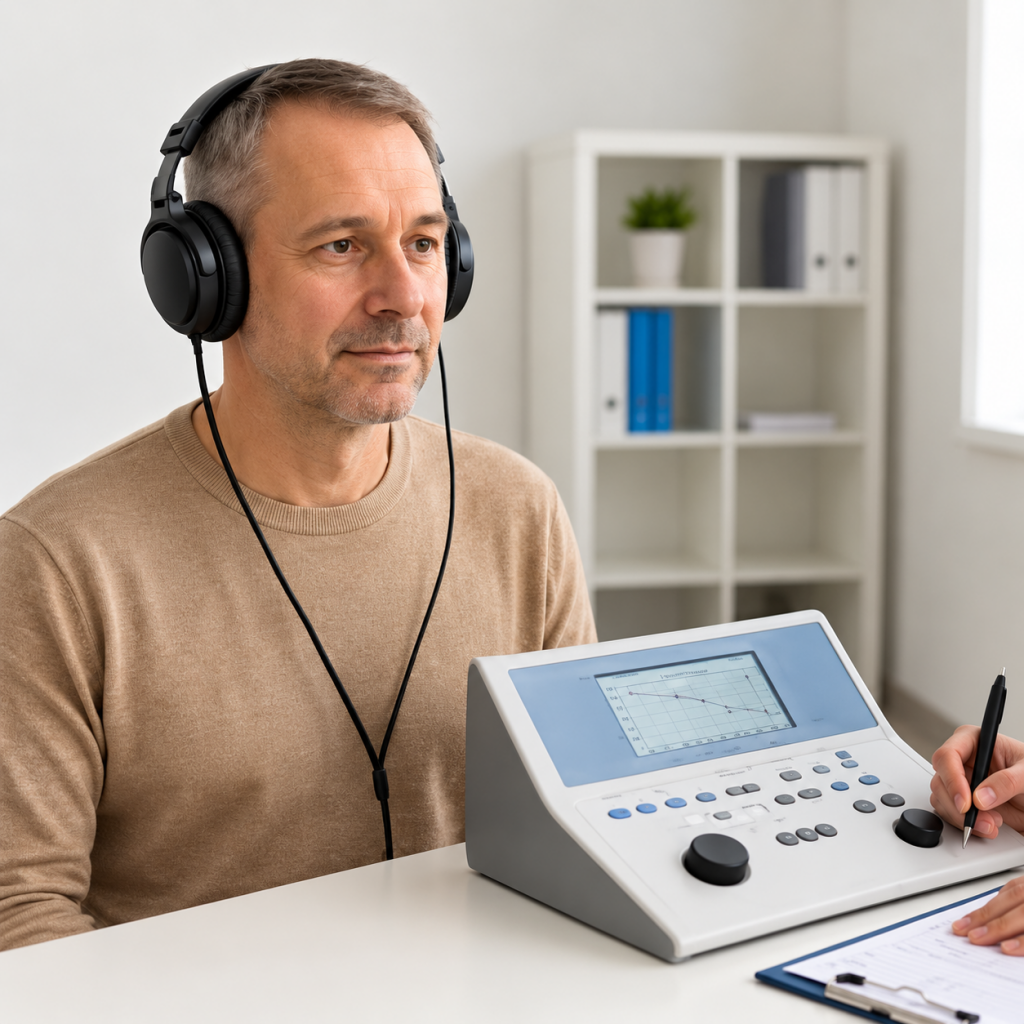
Why Is Audiometry Necessary Before Choosing a Hearing Aid?
Hearing aid fitting begins not with choosing a specific model, but with assessing the individual characteristics of a person’s hearing. Audiometry makes it possible to determine how well a person perceives sounds at different frequencies and volumes and provides information used for the subsequent selection and adjustment of a hearing aid.
The examination results help identify the nature and degree of hearing loss, determine the required level of amplification, and account for individual differences in sound perception.
What Does Audiometry Show?
Audiometry provides objective information about which sounds a person hears well and which are more difficult to perceive. One of the main results of the examination is an audiogram — a graphical representation of hearing thresholds at different frequencies.
Determining the Degree of Hearing Loss
During the test, the minimum volume of sounds a person can hear at different frequencies is determined. This helps assess the severity of hearing loss and identify its specific characteristics.
Hearing loss can vary across different frequencies. For example, a person may perceive low-frequency sounds relatively well but have greater difficulty hearing high-frequency sounds.
Testing the Perception of Different Frequencies
Different frequency ranges are important for understanding speech. Therefore, the examination assesses how well a person perceives sounds across several frequencies.
The results help the specialist determine which parts of the sound spectrum require greater amplification.
Determining Hearing Thresholds
The hearing threshold indicates how quiet a sound can be for a person to hear it at a particular frequency. The combined measurements form an audiogram.
It helps reveal the pattern of hearing loss and determine how much the hearing thresholds differ between the right and left ears.
Why Are Audiometry Results Important When Choosing a Hearing Aid?
A hearing aid must match not only the degree of hearing loss but also its specific characteristics. Therefore, audiometry results provide an important foundation for selecting a suitable device.
Selecting the Required Level of Amplification
Based on the examination results, the specialist determines the level of amplification needed at different frequencies. This helps prevent situations in which some sounds are not amplified enough while others become excessively loud.
Insufficient amplification may fail to provide good speech intelligibility, while excessive amplification can cause discomfort.
Considering Speech Intelligibility
The ability to hear sounds alone is not enough to assess hearing. Understanding speech is also important.
If a person can hear someone’s voice but has difficulty distinguishing words, the specialist takes this into account when selecting and adjusting the hearing aid.
What Is Considered When Analyzing the Results?
During the fitting process, the specialist considers:
-
the degree of hearing loss;
-
the hearing thresholds of the right and left ears;
-
the perception of different frequencies;
-
hearing thresholds;
-
speech intelligibility;
-
how loud and quiet sounds are perceived;
-
changes in hearing over time.
How an Audiogram Influences Hearing Aid Selection and Fitting
An audiogram helps determine the technical specifications required for a particular person. However, it does not, by itself, identify a single hearing aid model that is the only suitable option.
Which Characteristics Are Taken into Account?
Depending on the examination results, factors such as the hearing aid’s power, amplification adjustment range, and sound processing capabilities may be important.
The conditions in which the person will use the hearing aid are also considered: at home, outdoors, during group conversations, in noisy environments, or while talking on the phone.
Which Hearing Characteristics Are Considered During Fitting?
| Feature | What It Shows | How It May Be Used |
|---|---|---|
| Degree of Hearing Loss | How severe the hearing loss is | Helps determine the required level of amplification |
| Frequency Perception | Which frequencies are harder to hear | Amplification settings are adjusted for different frequencies |
| Differences Between Ears | Differences between the right and left ear results | Settings may be adjusted separately for each ear |
| Speech Intelligibility | How well a person understands spoken words | Taken into account when configuring speech processing |
| Perception of Loud Sounds | How a person responds to louder sounds | Helps establish a comfortable volume range |
Therefore, even two people with similar audiometry results may need slightly different settings.
Which Hearing Characteristics Are Considered During Fitting?
Audiometry results are an important part of the fitting process, but the specialist evaluates more than just the measurements shown on the audiogram.
Considering Everyday Listening Conditions
It is important to understand where and how a person most often experiences hearing difficulties. One person may need only comfortable speech perception at home, while another may need to understand conversation clearly in a noisy room.
The following factors may also influence the selection:
-
lifestyle;
-
frequency of social interaction;
-
the need to use a phone;
-
time spent in noisy environments;
-
wireless connectivity requirements;
-
ease of controlling the hearing aid.
Why the Same Degree of Hearing Loss Does Not Mean Identical Settings
Even when audiograms show the same measurements, people may perceive speech and environmental sounds differently. Audiometry therefore provides the specialist with an objective basis for fitting, but the final adjustments should also take the user’s individual experience into account.
What Happens After Audiometry?
After the examination, the specialist analyzes the results and uses them to guide the hearing aid selection process.
Individual Hearing Aid Fitting
Once a suitable hearing aid has been selected, it is adjusted according to the audiometry results. The specialist then evaluates how comfortably the person perceives speech and environmental sounds.
Settings may be adjusted gradually. This is especially important for new users who need time to adapt to amplified sound.
When Might Repeat Audiometry Be Necessary?
Hearing may be tested again if the results have changed or the previous settings no longer provide the usual level of comfort.
A repeat examination may also be helpful if a person notices worsening hearing, changes in speech intelligibility, or a significant difference between their previous and current perception of sounds.
Frequently Asked Questions
Can a Hearing Aid Be Selected Without Audiometry?
A comprehensive, individualized fitting is difficult without assessing hearing. Audiometry helps identify hearing characteristics and provides the information needed for subsequent hearing aid adjustments.
What Does an Audiogram Show?
An audiogram shows hearing thresholds at different frequencies and helps assess the nature and degree of hearing loss.
Can a Hearing Aid Be Selected Based on an Audiogram Alone?
An audiogram provides an important basis for hearing aid selection, but the specialist also considers speech intelligibility, everyday needs, listening environments, and the user’s subjective perception of sound.
Is Repeat Audiometry Necessary After a Hearing Aid Has Been Fitted?
Repeat testing may be necessary if hearing changes or new difficulties with sound perception arise. If the previous settings are no longer suitable, the results of a new examination may help the specialist adjust the hearing aid.
Conclusion
Audiometry before hearing aid selection is necessary to obtain an objective understanding of a person’s hearing. An audiogram shows hearing thresholds at different frequencies and helps identify the characteristics of hearing loss.
Based on these results, the specialist selects the necessary technical specifications and performs an individualized hearing aid fitting. The process takes into account not only the examination results but also speech intelligibility, everyday listening conditions, and the person’s subjective comfort.